Operational XRO Climate Forecasts
XRO model
The XRO is an eXtended nonlinear Recharge Oscillator model for El Niño-Southern Oscillation (ENSO) and other modes of variability in the global oceans (Zhao et al. 2024). It builds on the legacies of the Hasselmann stochastic climate model capturing upper ocean memory in sea surface temperature (SST) variability (Hasselmann, 1976), and the recharge oscillator model for the oscillatory core dynamics of ENSO (Jin, 1997). It constitutes a parsimonious representation of the climate system in a reduced variable and parameter space that still captures the essential dynamics of interconnected global climate variability. For the detailed formulation of XRO model, please refer to our paper (Zhao et al., 2024).
Data source
Operationally, we produce 18-month forecasts using the trained XRO model based on climate mode indices from 1982–2022, with initial conditions starting in January 2023. The XRO state vectors include ENSO and other climate modes, derived from:
Monthly SST anomaly indices, based on:
- OISST v2.1 provided by NOAA/PSL
- ERA5 provided by the Copernicus Climate Change Service (C3S)
- ORAS5 SST provided by C3S
- GODAS SST provided by NOAA/PSL
Monthly Warm Water Volume (WWV) index of equatorial Pacific upper-ocean heat content, based on:
- TAO data provided by NOAA/PMEL
- IAPv4 subsurface temperature provided by Lijing Cheng at IAP, Chinese Academy of Sciences
- ORAS5 D20 provided by C3S
- GODAS provided by NOAA/PSL
We conduct 1000-member stochastic forecasts with the same initial conditions for each month but different stochastic forcings, See Supplementary Fig. 16 in Zhao et al. (2024) for how we make 1000-member stochastic forecasts in details.
- Due to delays in TAO updates, the OISSTv2_IAPv4 version has been adopted for the official release starting June 2025.
- Due to delays in IAPv4 updates, the ORAS5 version has been adopted for the official release starting June 2026.
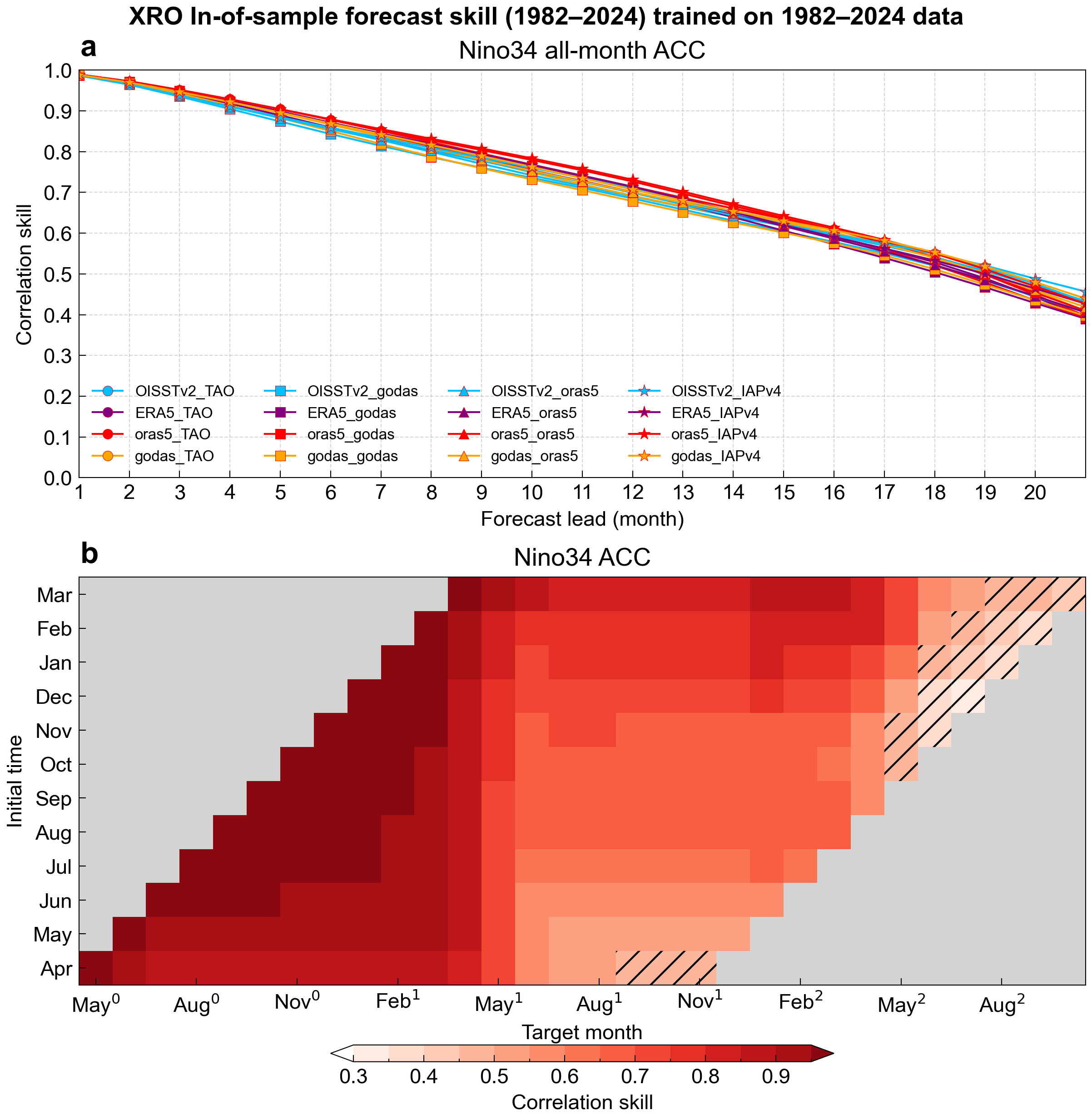
ENSO forecast skill
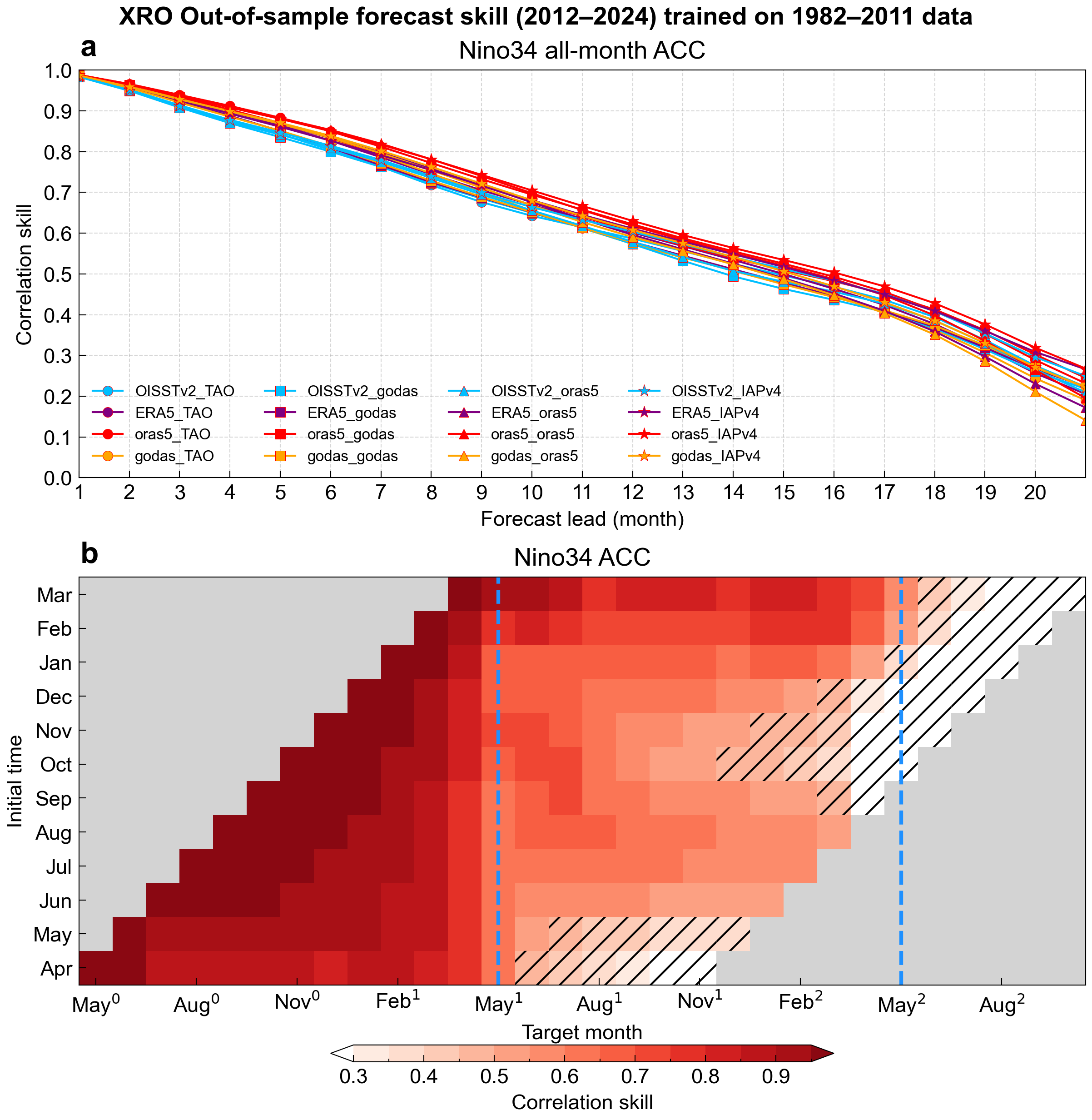
OISSTv2_godas, ERA5_oras5, etc.).
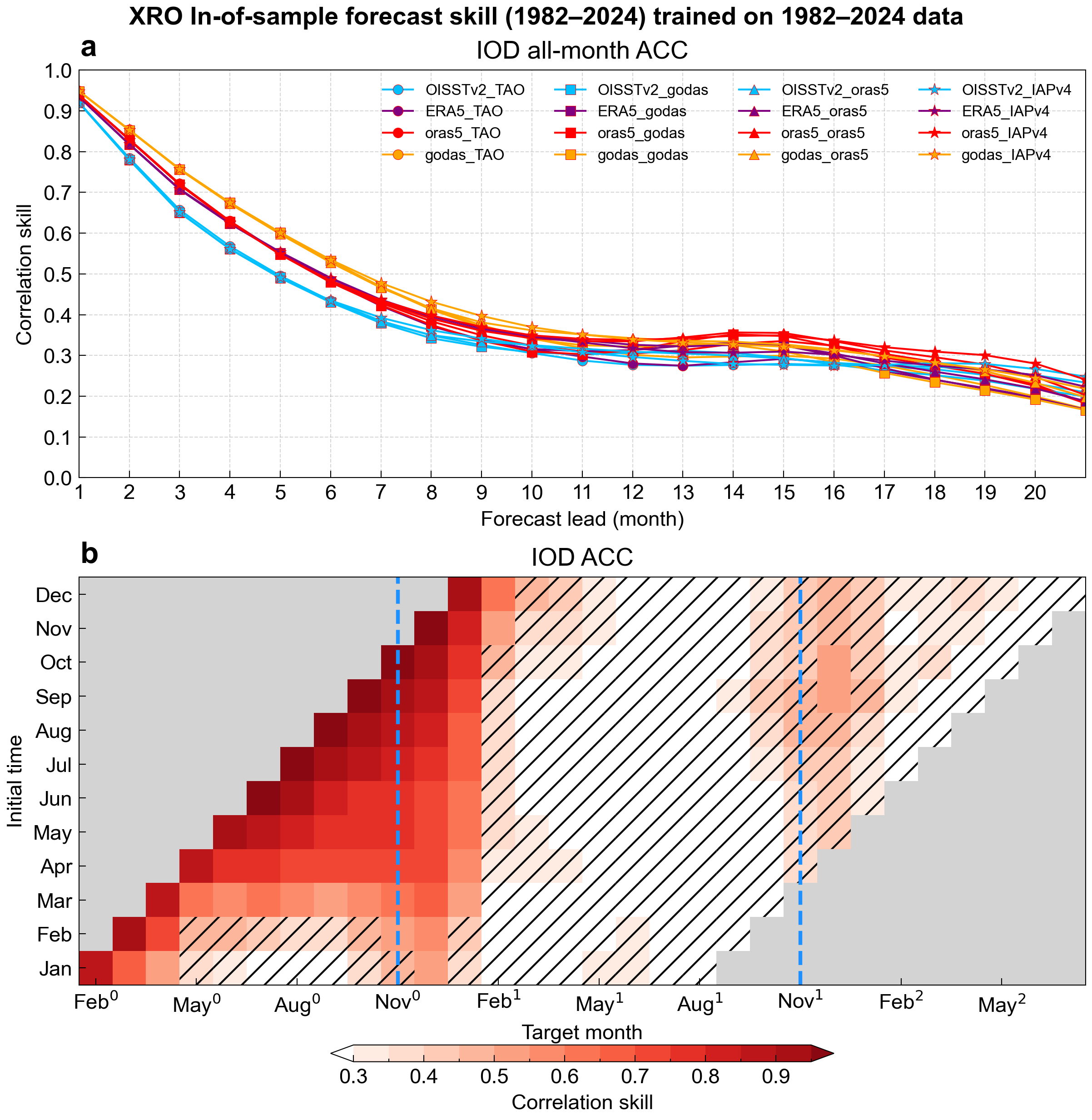
IOD forecast skill
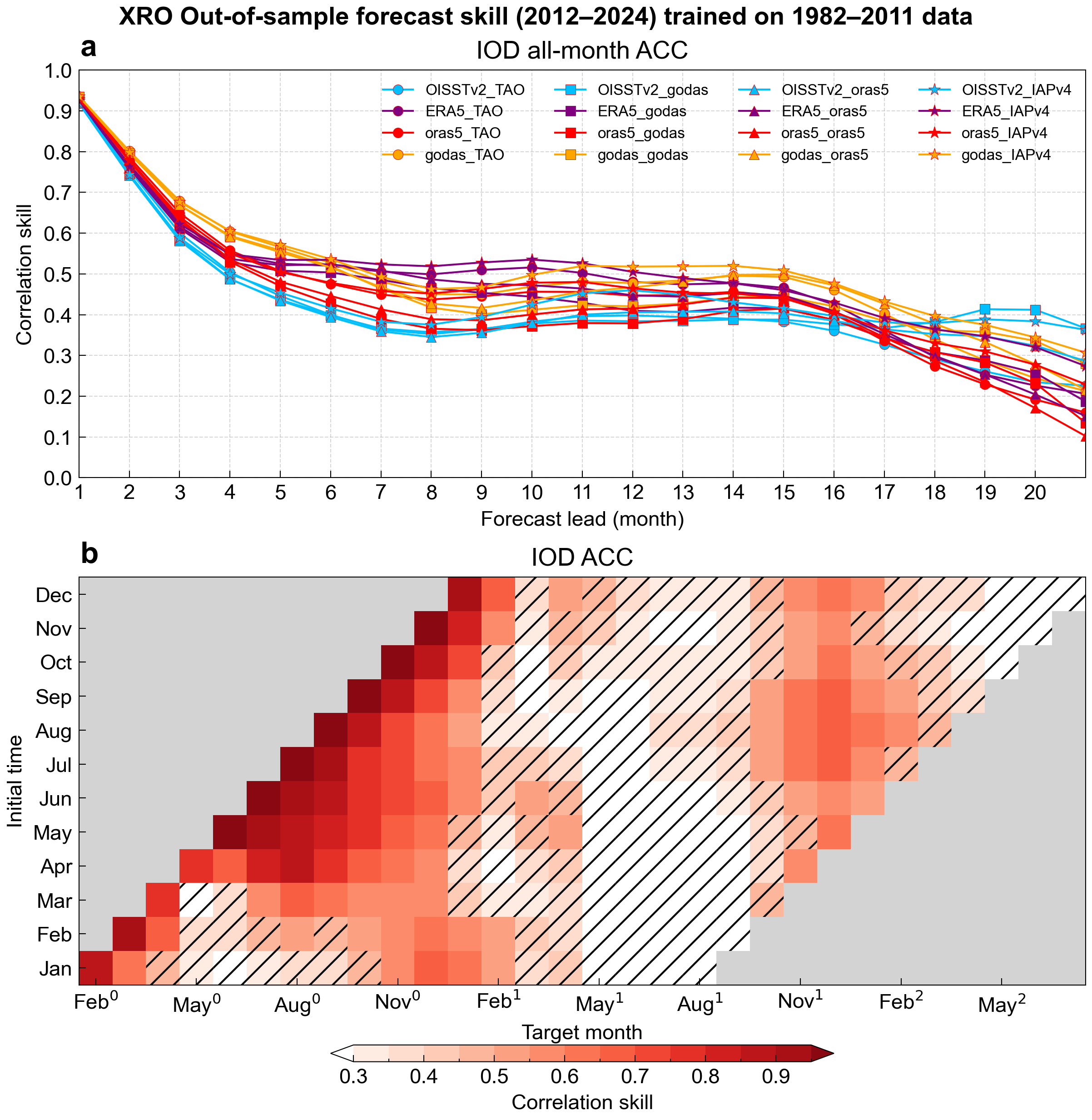
OISSTv2_godas, ERA5_oras5, etc.).
References
- Zhao, S., Jin, F.-F., Stuecker, M. F., Thompson, P. R., Kug, J.-S., McPhaden, M. J., et al. (2024). Explainable El Niño predictability from climate mode interactions. Nature, 630(8018), 891–898. https://doi.org/10.1038/s41586-024-07534-6
- Jin, F.-F. (1997). An equatorial ocean recharge paradigm for ENSO. Part I: conceptual model. Journal of the Atmospheric Sciences, 54, 811–829. https://doi.org/10.1175/1520-0469(1997)054<0811:aeorpf>2.0.co;2
- Hasselmann, K. (1976). Stochastic climate models Part I. Theory. Tellus, 28(6), 473–485. https://doi.org/10.1111/j.2153-3490.1976.tb00696.x